What Are the Fire Lane Striping Requirements for Commercial Parking Lots?
Table of Contents
- Introduction
- Why Fire Lane Striping Is a Legal and Safety Requirement
- National Fire Lane Standards: What the NFPA Requires
- Fire Lane Width and Clearance Requirements
- Pavement Marking Standards for Fire Lanes
- Fire Lane Color Requirements: Red, White, and Why It Matters
- Signage Requirements That Work Alongside Pavement Markings
- Dead-End Fire Lane Turnaround Requirements
- Missouri-Specific Fire Lane Standards to Know
- How Often Should Fire Lane Markings Be Inspected and Refreshed?
- Common Fire Lane Striping Mistakes on Commercial Properties
- Conclusion
- Frequently Asked Questions
Key Takeaways
- Fire lanes must maintain a minimum width of 20 feet under National Fire Protection Association guidelines, along with a vertical clearance of at least 13 feet 6 inches.
- Missouri requires fire lanes to be marked within 150 feet of building entrances, and markings must remain clearly visible at all times.
- Red-painted curbs or pavement edges with “FIRE LANE – NO PARKING” stenciled in white letters are the standard configuration.
- Reflective signage must accompany pavement markings, typically spaced every 25 to 50 feet.
- Dead-end fire lanes over 150 feet require an approved turnaround area, and property owners are responsible for year-round maintenance.
Introduction
Fire lane striping requirements for commercial parking lots are governed by a combination of national safety standards and local building codes. The primary frameworks come from the National Fire Protection Association and the International Code Council, which publishes the International Fire Code (IFC).
For commercial property owners in Missouri, and particularly in the Kansas City area, these standards define the minimum width, color requirements, signage placement, and maintenance obligations for fire apparatus access roads located on private property.
Failure to comply can create serious safety hazards and may expose property owners to fines or liability if emergency response is delayed due to blocked or poorly marked fire lanes.
Why Fire Lane Striping Is a Legal and Safety Requirement
Fire lanes exist to ensure that emergency vehicles can reach a building quickly and without obstruction. Their effectiveness depends entirely on visibility and enforcement.
On private commercial lots, the responsibility for maintaining fire lane striping falls on the property owner or facility manager — not the city. If markings fade or signage becomes damaged, compliance gaps can develop quickly.
Clear, highly visible striping supports enforcement. Without proper markings, authorities may have difficulty issuing citations to vehicles parked illegally in the fire lane.
National Fire Lane Standards: What the NFPA Requires
The National Fire Protection Association establishes baseline standards adopted across the United States. These standards are commonly reinforced through the International Fire Code published by the International Code Council.
NFPA and IFC guidelines require that fire lanes:
- Provide sufficient width for fire apparatus
- Maintain required vertical clearance
- Remain clearly marked and visible under various lighting conditions
While national standards set the baseline, municipalities may adopt stricter local codes. A property meeting NFPA minimums could still fall short of local enforcement standards.
Fire Lane Width and Clearance Requirements
Under NFPA and IFC standards, fire apparatus access roads must be at least 20 feet wide. Some building types — particularly taller or higher-occupancy structures — may require wider lanes.
Vertical clearance must measure at least 13 feet 6 inches along the entire fire lane. This includes eliminating obstructions such as:
- Overhanging tree branches
- Canopies or awnings
- Utility lines
Maintaining clearance is an ongoing responsibility, not a one-time installation requirement.
Pavement Marking Standards for Fire Lanes
Proper pavement marking typically includes:
- A red-painted border at least 6 inches wide
- Repeated stenciled text reading “FIRE LANE – NO PARKING” or “NO PARKING – FIRE LANE”
- Lettering at least 4 inches tall
- Text repetition every 25 to 50 feet
If a curb borders the fire lane, the vertical curb face is painted red instead of the pavement surface to improve driver visibility.
Fire Lane Color Requirements: Red, White, and Why It Matters
Red is the universally recognized color for fire lane designations in the United States. It immediately signals emergency access and no-parking restrictions.
The stenciled wording is typically painted in white for maximum contrast. Some jurisdictions recommend adding reflective glass beads to improve nighttime visibility — particularly important in areas with long winter evenings and reduced natural light.
Using incorrect colors such as yellow or orange may result in compliance issues during inspection.
Signage Requirements That Work Alongside Pavement Markings
Pavement markings alone are not enough. The International Fire Code requires permanent signage to reinforce the restriction.
Standard fire lane signs typically:
- Measure 12 inches by 18 inches
- Display red lettering on a white reflective background
- Read “NO PARKING – FIRE LANE”
- Are mounted at least 6 feet 6 inches above grade
- Are spaced every 25 to 50 feet
Both signage and pavement markings must remain legible and unobstructed.
Dead-End Fire Lane Turnaround Requirements
Dead-end fire lanes longer than 150 feet require an approved turnaround area. Without one, emergency vehicles may be forced to reverse long distances, delaying response time.
Common solutions include:
- Cul-de-sac configurations with a minimum 50-foot outside turning radius
- Hammerhead (T-shaped) turnarounds
These areas must also be marked clearly to prevent parking or obstruction.
Missouri-Specific Fire Lane Standards to Know
Missouri fire lane requirements align closely with the International Fire Code. In many cases, fire lanes must be clearly marked within 150 feet of building entrances. In Kansas City, the local fire department has authority to inspect properties and issue correction notices if fire lanes are faded, improperly marked, or obstructed.
Maintaining documentation of inspections and restriping work helps demonstrate proactive compliance.
How Often Should Fire Lane Markings Be Inspected and Refreshed?
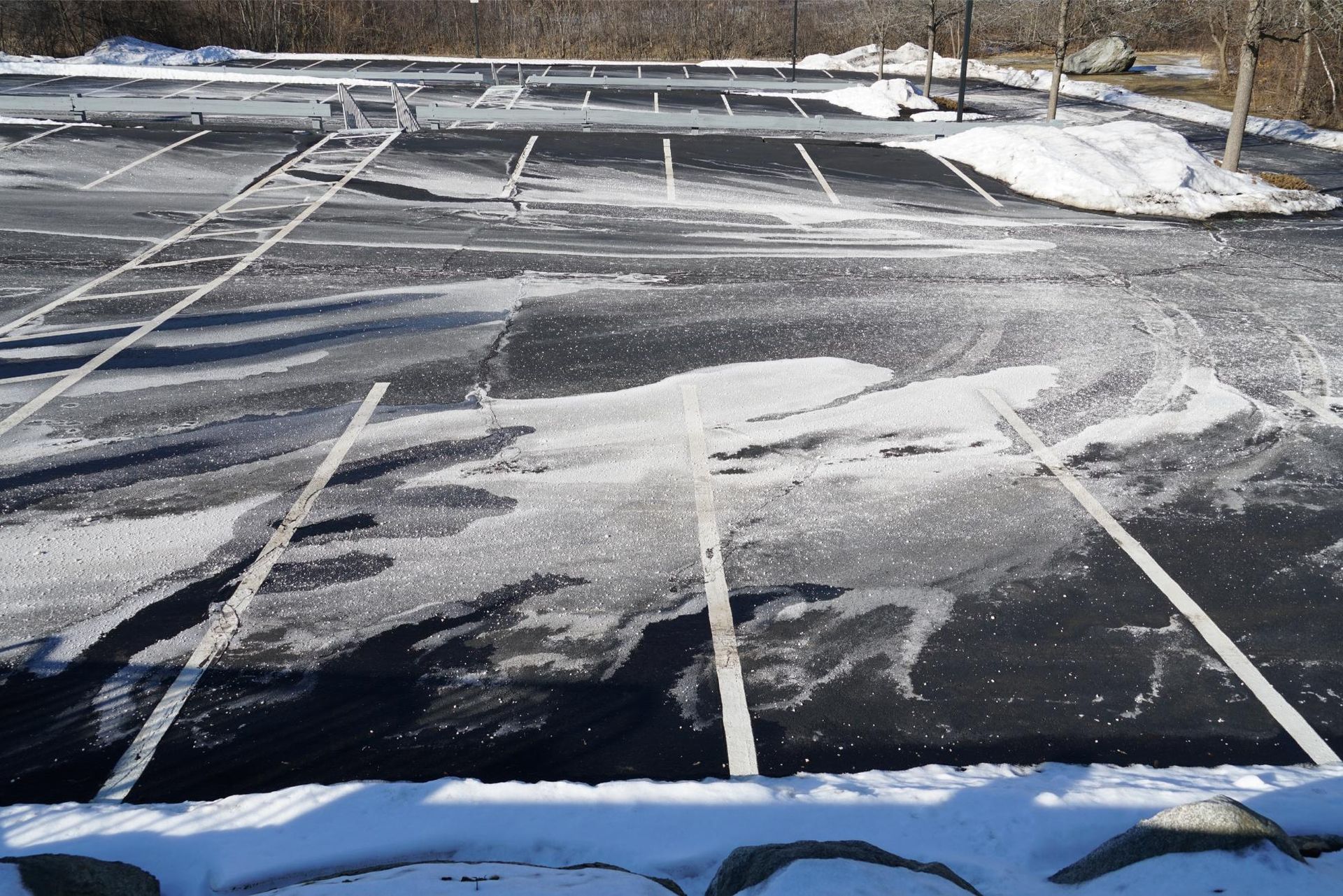
Fire lane striping is exposed to constant wear from:
- Vehicle traffic
- UV exposure
- Freeze-thaw cycles
- Snow removal equipment
At minimum, commercial properties should inspect fire lane markings once per year. High-traffic sites may require biannual inspections.
Thermoplastic striping materials can extend longevity to 3–7 years, compared to 1–2 years for standard water-based paint.
Common Fire Lane Striping Mistakes on Commercial Properties
Frequent compliance issues include:
- Using incorrect paint colors
- Failing to repeat stencil text at proper intervals
- Missing or faded signage
- Allowing landscaping or snow piles to obstruct visibility
A full compliance review should assess both pavement markings and signage together.
Conclusion
Fire lane striping requirements for commercial parking lots are defined by national standards from the National Fire Protection Association and the International Code Council, as well as Missouri and local municipal regulations.
To remain compliant, property owners must ensure:
- A minimum 20-foot lane width
- 13-foot 6-inch vertical clearance
- Red-painted borders and compliant stencil wording
- Properly spaced reflective signage
- Turnaround areas for qualifying dead-end lanes
- Ongoing inspection and maintenance
Fire lane compliance is both a legal responsibility and a life-safety requirement. Proactive maintenance protects building occupants, reduces liability exposure, and ensures emergency responders can do their job without delay.
Book Fire Lane Striping Services Today
If your commercial property needs updated or fully compliant fire lane markings, now is the time to act. Professional striping ensures your lot meets NFPA, IFC, and Missouri standards while improving visibility and enforcement.
Book a Fire Lane Striping Service today to keep your property safe, compliant, and inspection-ready.
Frequently Asked Questions
How wide must a fire lane be on a commercial property?
Under NFPA and International Fire Code standards, fire lanes must be at least 20 feet wide, though certain building types may require additional width.
What color is required for fire lane striping?
Red is the standard color for borders and curbs, with white stencil lettering for contrast.
Are signs required in addition to painted markings?
Yes. Permanent reflective signage must accompany pavement striping and be spaced according to local code requirements.
How often should fire lane striping be refreshed?
At least annually, or whenever markings show visible fading or damage.
Who is responsible for maintaining fire lane markings on private property?
The property owner or facility manager is responsible for maintaining compliant fire lane striping and signage.
Related Posts